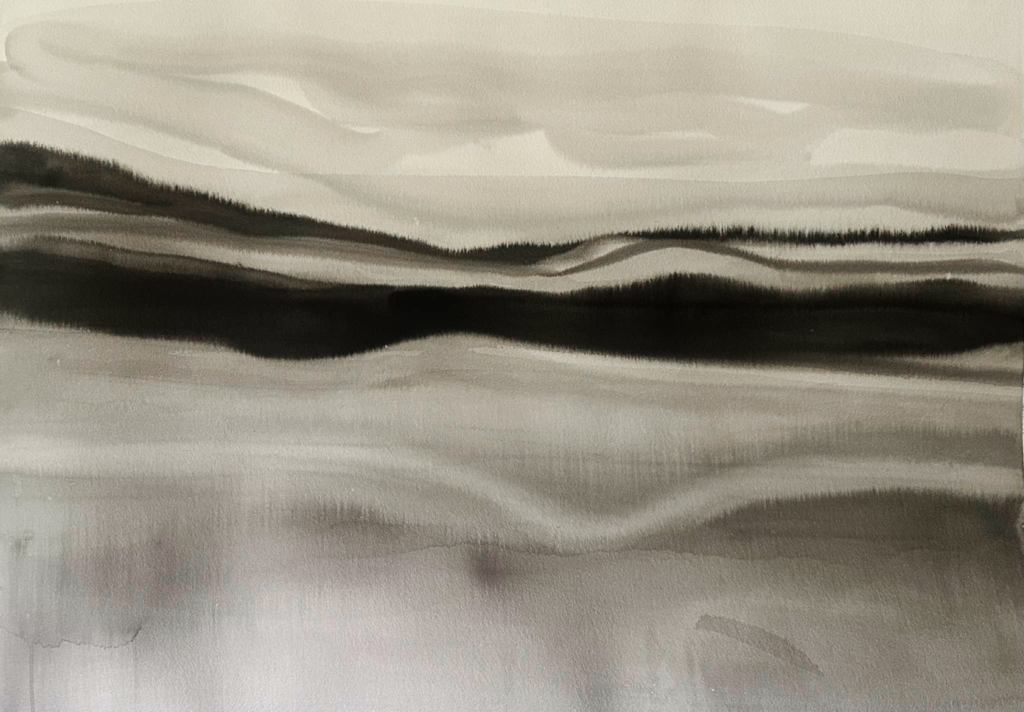
Songlines Landscape – Artistic Research Through Painting, Places and Autobiography
In the art project Songlines Landscape, I draw inspiration from the ancient Aboriginal tradition of songlines, a central element of Indigenous Australian cultural and spiritual expression. Through artistic interpretations of these songlines, I seek to develop a deeper understanding of how landscapes and journeys can shape our inner experiences and autobiographical narratives. The songlines serve as a key to understanding the autobiographical dimension of my work—not merely as an outward journey through different geographical locations, but also as an inner passage through life’s challenges and experiences.
In Aboriginal culture, songlines are a way of mapping the landscape through song, with each line representing a path that follows the journeys of the ancestors. These songs are not simply a means of navigation; they also weave together history, spirituality and culture. By reinterpreting this ancient concept, I aim to develop a contemporary visual language that reflects my own journey—not only through physical movement, but also through an exploration of my inner life and artistic experiences.
My interpretation of songlines thus becomes a portrait of encounters—with people and places, but also with myself. As I move through different landscapes, cities and countries, and reconnect with my own experiences of these places, I create a kind of mapping of the ways in which these journeys leave their mark on me as both an artist and an individual. In this way, Songlines Landscape becomes an autobiographical journey through which I explore how different places and moments in life have shaped my artistic expression.
For me, travelling and exploring are essential to life itself. These journeys spark the impulse to create, as every new place, every encounter, and every shift in light and surroundings becomes a source of inspiration. The colours of the day, the nuances of warmth, the tangible movement of life and, at times, its chaos—even the exhaust fumes and traffic of a city—become part of the artistic landscape. These everyday impressions shape my artistic expression, as each day and each place has its own melody, like a musical scale moving between minor and major keys.
In a sense, my painting becomes a kind of interim report—a quiet yet powerful account of the life lessons I have gathered over the years.
As I work on Songlines Landscape, I seek to reconnect with earlier artistic experiences, revisiting my first steps as an artist and my search for a personal visual language. I attempt to rediscover those formative moments when, through long walks to the sea and quiet hours spent on the beach, I sought to find my artistic voice. These early experiences have left a deep impression on me, and today I strive to reclaim these memories through art. My return to watercolour after many years away from the medium has become part of this process, allowing me to capture the impressions and emotions that emerge from my encounters with the landscape.
It is here that I find a connection between my artistic practice and the Aboriginal concept of songlines—a deeper relationship between place, memory and identity. By mapping my own journey, not only through landscapes but also through the course of my life, I explore how these different dimensions intertwine and find expression in my work.
Rather than following a strict plan or predetermined concept, I try to allow colours, forms and textures to emerge organically, much as songlines arise from the land and become an integral part of the landscape. This experimental and intuitive approach allows me to create conceptual paintings while maintaining a strong connection to the tangible world, both through my personal experiences and through the places I paint.
Songlines Landscape thus becomes a way of mapping not only my journey through the world, but also my own inner landscape, with each painting expressing the complex interplay of place, time and emotion.